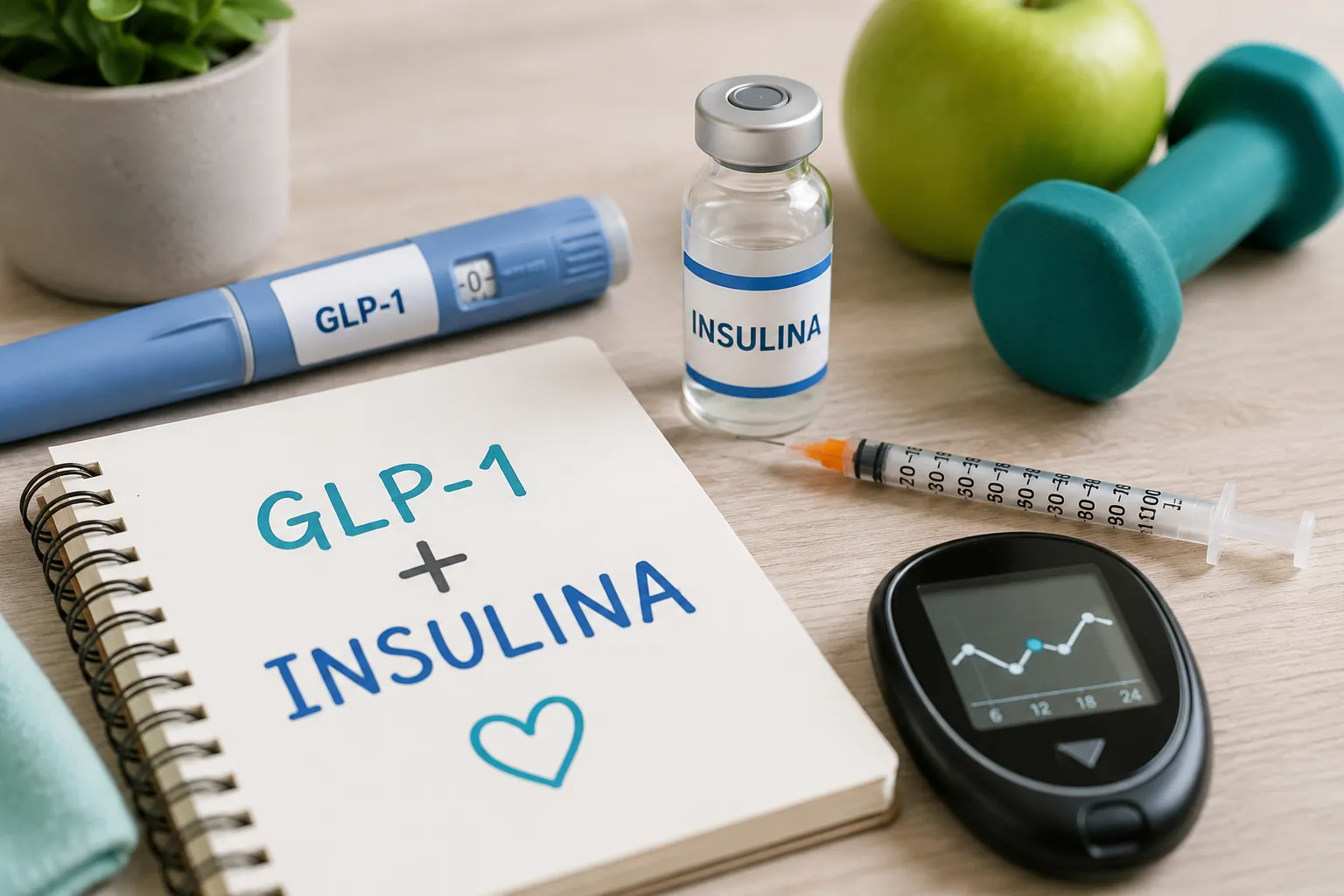

Those of us who live with type 1 diabetes know that, no matter how many advances we have seen in sensors, pumps and closed loop systems, there is something that has practically not changed: insulin continues to be the essential basis of our treatment.
That is why I find research that is being carried out, among other centers, at the Hospital Clínic of Barcelona, especially interesting. Several trials are studying whether GLP-1 receptor agonist drugs, best known for their use in type 2 diabetes and obesity, could also provide benefits to people with type 1 diabetes.
And it is worth making something very clear from the beginning: we are not talking about replacing insulin.
In type 1 diabetes we need insulin because our body does not produce the necessary amount. What is being investigated is whether GLP-1 could be used as a complement to insulin therapy and achieve an additional metabolic benefit.
Why might it be interesting?
We have long associated type 1 diabetes with young, thin people. But those of us who live with it know that that image has become quite outdated.
We can have type 1 diabetes and, at the same time, be overweight or obese, insulin resistant, or have difficulties controlling weight. In fact, as explained by endocrinologist Jesús Blanco, current studies show that overweight and obesity among people with type 1 diabetes have a prevalence similar to or even higher than that of the general population.
And here an important issue arises: having type 1 diabetes does not protect us from the same metabolic problems that affect the rest of the population.
If, in addition to needing insulin, we are overweight, insulin needs may increase and daily management may become even more complex. That is why it makes sense to investigate complementary treatments.
What are they trying to prove?
The trials want to test whether adding a GLP-1 agonist to regular insulin treatment can improve the clinical and metabolic behavior of type 1 diabetes.
In Spain, centers such as the Hospital Clínic of Barcelona, Germans Trias i Pujol, Hospital de Badajoz, Ramón y Cajal and Virgen del Rocío are participating, within a much broader international investigation in which it is expected to recruit around 271 patients.
One of the aspects that seems most hopeful to me is precisely this: for years we have had very few pharmacological options beyond insulin.
We have greatly improved the way we manage it and measure our glucose, but one day having new complementary tools could represent another important step.
But we're still talking about research.
The fact that there are clinical trials does not mean that GLP-1 is already a general treatment indicated for type 1 diabetes, nor that we should try to use it on our own. Precisely these studies have to determine what benefits they provide, what risks exist and in which patient profiles it might make sense to use them.
And we must not forget that these medications can have adverse effects and that any change that affects insulin needs in a person with type 1 diabetes requires special care.
Therefore, do not interpret headlines like "GLP-1 will replace insulin." That is not what is being investigated.
Personally, after so many years living with diabetes, any research that expands our therapeutic possibilities seems like good news to me, as long as it is supported by scientific evidence.
Sensors, pumps and algorithms have greatly changed our quality of life. Perhaps the next leap is not only to manage insulin better, but also to find complementary treatments that make it easier to control everything that surrounds diabetes.
The results will still take time. According to the forecasts included in the article, we could have clearer conclusions in approximately three years.
Until then, we have to wait for the data.
Do you currently use any GLP-1 in addition to insulin?
Has your endocrinologist ever asked you about it?
What experience have you had?